

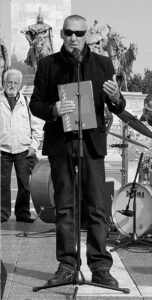

The professional career of graphic artist Győző Sárkány
Győző Sárkány’s graphic oeuvre started in the early 1980s and can be divided into several periods. “His first period can be characterised by surrealism at the umpteenth power: possessing apperception skills, using the analogy of a particular transcendent literary category – microrealism.” (János Frank)
On the one hand, his detail-rich graphics were inspired by pop art (creased surfaces, crowded image space), and on the other hand, they were touched by the classical traditions of Hungarian drawing art.
“These early creations summon meticulously drawn landscape fragments, the cemetery of tank wrecks, birds, and parts of Esterhazy Madonna; they contrast beauty-tenderness with violence-war, and can be associated with the object fetishism and montage-like compositions of hyperrealism as well as pop.” (Lajos Lóska) The primary characteristic of this era is the synchronisation of moral content and carefully elaborated, brilliant visual display which continue in the late 80s in his works recalling Dürer’s traditions (AD emlékére I–II. – To AD’s memory I–II).
From the early nineties, large-size balanced geometrical forms and gesture-like, splashing dynamic solutions connected to abstract expressionism appear together on the graphics and screen prints, for example in his works Misztrál I–II. (Mistral I–II), Légvonal I–III. (As the crow flies I–III) (1995), Sztratoszféra I–II. (Stratosphere I–II) (1996), and Mandelbrod I–II. (1997). The series of compositions demonstrating his convincing knowledge of drawing return on his pages of pastel and unique graphics (Változat I–III. (Variations I–III) 1996).
His illustrator career is characterised by about 50 illustrated books, also acknowledged by the profession several times (Rostand, Verne, Madách, Radnóti). Between 1997–1998 he created 300 Verne illustrations, and designed 75 volumes of the book series. His illustrations are made exciting by considerate compositional editing and virtuoso drawing talent. He has always paid great attention to creating a balance between the authentic depiction of the intellectuality of literary works and his own artistic attitude. Inter alia, this approach is reflected in his illustrations prepared for the works Sillanpää: Hiltu and Ragnar (1998), Bryusov: Márványfejecske [Little marble head] (1990), Schmuckler: Rekviem Theophilért [Requiem for Theophil] (1991), and Rostand: Sasfiók [The Eagle] (1993), and for ones published in a series by Unikornis Kiadó [Magyar dráma gyöngyszemei (Gems of Hungarian drama), 1994], and the drawings created in connection with the abovementioned Verne series in 1998. He was awarded with the Ferenczy Noémi Prize for his illustration work in 1997.
Győző Sárkány’s oeuvre includes visual graphics and illustrations that encompass several genres, art books (cast art books), and paper sculptures (for example Híranyag (News material) 1994; Dürer könyv (Dürer book) 1995; Jeles könyv (Book with signs) 1995). As a result of his study visits from 2000, the synchronisation of the special phenomena of Western and Eastern cultures and the placement of different views of the world in the same context are more and more visible in his works. It was the time he started to combine the characteristics of style periods and trends in art history (Renaissance, Baroque, Surrealism, etc.) with the unique formal world of prehistoric cultures and archetypal images. The depictions of ancient masks and “body masks” opened a new era of his artistic approach and thinking, which was in a close context and unity with his his earlier work. Leporelló (Leporello), his exhibition organized in 2008 in the Gaál Imre Galery connected various shapes and ideas through works such as Körmonolit (Circle monolith), Oválismonolit (Oval monolith), Tömbmonolit (Block monolith), Arc (Face), Maszk (Mask), Testmaszkok (Body masks) and Relativitás (Relativity). He has drawn about 500 pictures on this theme. The formal solutions of the works cannot be classified according to a uniform principle, because organic microstructures can also be found in geometrical shapes, and we can also see the cold safety of closed geometrical structures in the baroque of acute mergers and curvature. A graphite pencil and white paper are enough for the artist to create a musical world that is always full of shades and formal systems, swirling, drifting, fading and intensifying, darkening.
”His works can mostly be considered visual essays as thely are looking for fullness, the presentation of more sides of a single thing, and, therefore, knowledge”. Győző Sárkány explains the basic principles of his own thinking in his graphics, looking for the hidden structures of reality. The series built up from his pictures cohere into a philosophical system which explores the idea of finite memory and immeasurable time with the mediative monotonity of a thorough working method, and conveys spiritual contents with the help of geometrical rules, balancing between exploring and hiding attitudes.” (Judit Szeifert)
Győző Sárkány is an important figure of contemporary Hungarian art not only as an artist, but also as an arts organiser. He has been a founding chairman of the Society of Hungarian Illustrators since 1994. He published 14 catalogues and organised two banquets – in 1999 at the Frankfurt Book Fair, and in 2006 at the Bologna Book Fair – where the art of Hungarian illustration was presented to the world in a representative way. He has been vice-chairman of the National Association of Hungarian Artists (MAOE) since 2000, and chairman of the Hungart Association since 2003, where he published 38 art monographs on the theme of contemporary fine art, industrial art and photography. He was a founding member and vice-chairman of the Association of Hungarian Fine Arts and Applied Arts Societies in 2005, and has been represententing the members of the public body of the Hungarian Academy of Arts since 2014.
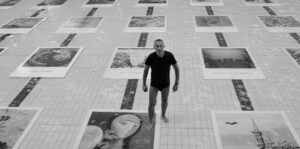
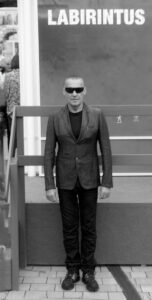
He was one of the people starting MAOE’s artistic salon exhibitions in 2012, a mastermind behind the theme of the exhibitions, and the designer of their visualisation, installations and catalogues. Each of these exhibitions featured a characteristic project and installation out of the conventional spatial framework. In 2013 he created the concept of the Underwater exhibition of the Four elements exhibition series, which was a unique and unconventional event creating a new style. The 2014 Labyrinth exhibition was accompanied by a monumental installation system built in the courtyard of Art Mill – the walls of 63 square metre Labyrinth House were covered by digitalised copies of the original works by 610 artists and their repetitions, further strengthening the labyrinth experience. The 2015 Harmony exhibition included a 500 square metre architecture installation placed on the building of the V8 City Swimming Pool with 6×6 metre enlarged versions of works by 11 artists, and the 1×1.8×12 metre installation system of Harmony-Space-Image, where the works and portraits of artists were documented by the two sides of 15×15 cm squares. These projects created an opportunity to break out of the conventions of exhibitions in a strict sense, extending its scope in time and space. He also designed an installation system that could be walked around and was suitable for the specific spatial conditions of the 2017 Chaos and Order exhibition organized in Reök Palace, Szeged.
The complexity of Győző Sárkány’s oeuvre is not only demonstrated by a diversity of genres, but also by his multipicity of style, or postmodern characteristic if you like. Each of his works are nicely crafted, deliberate and autonomic pieces.
At the occasion of the 500th anniversary of the Reformation, he has created an especially exciting selection of works titled Fall of idols / 50 pictures – 50 ideas for the representative exhibition organized at Gaál Imre Galery. According to the concept of the exhibition, the 50 drawings are accompanied by 50 thoughts (writings by artists, writers, scientists, musicians, etc.), almost like an “intellectual installation” of the pictures. The scale of the graphic plates (100×70 cm, plate lithography) already represents considerable suggestive power, and the black and white visual image of the exhibition is elegant and solemn in its exactness. The dynamism arising from the structure of the compositions and the free flow of forms create a feeling of continuity, and bring the pieces of the series together into a unity of content. The basic elements of works related to Reformation are the lines, characteristic forms and quotes from cultural history appearing in Győző Sárkány’s works again and again as permanent markers of his art. His compositions possess symbol-creating power, and are permeated by intended duality; the dichotomy of concealment and revelation, hiddenness and discovery is conveyed by a complex system of soft and hard stroke lines, and fields that are left empty or obscured and shaded.
The concreteness of space and time does not affect this artistic world, which includes historical, philosophical and theological thought experiments, quotes of styles and works, and paraphrases in the unquestionable evidence of simultaneity. The profane picture-text iconostasis displayed in a separate room of the exhibition serves as a special Gesamtkunst experiment and also warns that Reformation gave us both the freedom and burden of responsibility. It placed us into the gate between past and future, to safeguard our present alertly, with a pure heart.
In connection with the 100th anniversary of the fateful historical event, Győző Sárkány has organized exhibitions titled Trianon Anzix (Trianon Postcard) at several locations in 2020.
The exhibition evokes the 100th anniversary with 100 black and white graphic pages (mixed media, 70×50 cm). The dark-light rhythm of the juxtaposed compositions is a powerful expression of the drama of the country’s shocking human and territorial loss. The artist does not approach the theme with the usual narrative perspective; his aim is to view our own historical tragedy in a world-historical dimension spanning beyond the nation.
Trianon Anzix can be associated in many respects with the exhibition The fall of idols / 50 drawings – 50 thoughts organized on the 500th anniversary of the Reformation in 2017 and the accompanying publication. A black piece in terms of the dramatical character of its subject, a second “white book” that could already sublimate tragedy was published in 2020 as a complementary of the first “white book”.
“The battle which our ancestors once fought through recollection is resolved in peace,” − writes Attila József. Creating with this in mind, Győző Sárkány sheds light not on concrete losses but on a community of human dramas, the relativity of historical justice and injustice. In each drawing, he consciously blurs elements of the historical and individual spheres, emphasizing their inevitable connections.
He uses the perspective of the modern man to approach this historical drama which has been interpreted and rethought in many ways over the past hundred years. Győző Sárkány discovers the innermost emotional core of the tragedy in a community of human existence and destiny manifested in innumerable variants. The motifs, symbols and emblems appearing in the compositions can sometimes be interpreted as concrete references, but in fact the 100 graphics form a single, coherent string of thoughts appearing in images.
In the autumn of 2020, the artist presented a new exhibition entitled Köztes képek (Intermediate Images), which is a spontaneous − 50-work − summary of 42 years of his creative work between 1978 and 2020.
His next major project is to mark the 700th anniversary of Dante’s death. These works, like the previous ones, form a coherent series, the theme of which is linked to Dante’s Divine Comedy in a primary reading. The artist evoked Dante in an ensemble of works combining freely edited visual and linguistic elements, one of the key messages of which is the importance of a personal experience. Although his oeuvre uses the tools of a completely new artistic language, photography, it is not surprising that the Puritan structure, elegant colour treatment and cropping of his photographs link his works to earlier stages of his oeuvre. In a way, the exhibition of the photo can be linked to the pandemic, since the past year has changed our daily routine and, in addition to its negative effects, has almost encouraged us to turn inwards, seeking new paths and possibilities. For Győző Sárkány, the forced retreat brought an intense turn to nature. His photographs, free of any kind of subsequent manipulation, have been created as an organic continuation of his earlier graphics; the train of thought, questioning and paraphrasing that have been present so far can be noticed here too. In these series, the artist reflects on a theme in many different ways: his newer works are pieces of an interconnected chain, further interpreting and harmonising the works he had created earlier (Bálványok bukása − The Fall of Idols; 50 drawings − 50 thoughts and Trianon anzix − Trianon Postcard; 100 drawings − 100 sentences). The publication accompanying Végtelen színjáték (Infinite Comedy) joins the line of the previous two “white books” as the third piece of the trilogy.
Graphic artist Győző Sárkány has taken part in about 310 group and 27 individual exhibitions. He received the Artist of Merit award for his oeuvre in 2012, and the Knight’s Cross of the Order of Merit of the Hungarian Republic for his work for community in 2015.
In 2023, a large-scale exhibition of the artist’s oeuvre was held at the Reök Palace in Szeged, entitled Létidő, and a representative publication of his complete oeuvre was published on this occasion.